Last week I posted a question:
Out of 10, how would you rate your actual day-to-day experience of building your company right now?
How it came about is that I’m a computer engineer by nature and training, who just happened to turn into a founder performance psychology practitioner and I still find myself thinking in charts and mental models.
What I’ve learned early on is that whatever you tend to measure – whether it’s weight on your scale, calories you eat, habits you track, revenue you generate, ideas you come up with, profit you keep, dates you go on, push-ups you do, taxes you owe, connections you follow up on – what you focus on simply gets to be managed and improved.
Early on in my wonderful computer engineering career running a consultancy business – I’ve got the performance numbers down.
I was growing, I was performing.
But I didn’t feel like it.
So I devised a wonderful plan to simply check-in with myself: How do I feel day-to-day out of 10?
Unknowingly, I’ve kept up with this practice over the last 10 years or so.
It just so happens that most of the time I wasn’t feeling that great.
My experience didn’t match the external picture others were observing from the outside.
What was also the more frustrating part was that the external success was there – but the internal satisfaction, happiness and fulfillment – was not!
Yesterday I came across this Startup Curve chart post by Jamie Reynolds:
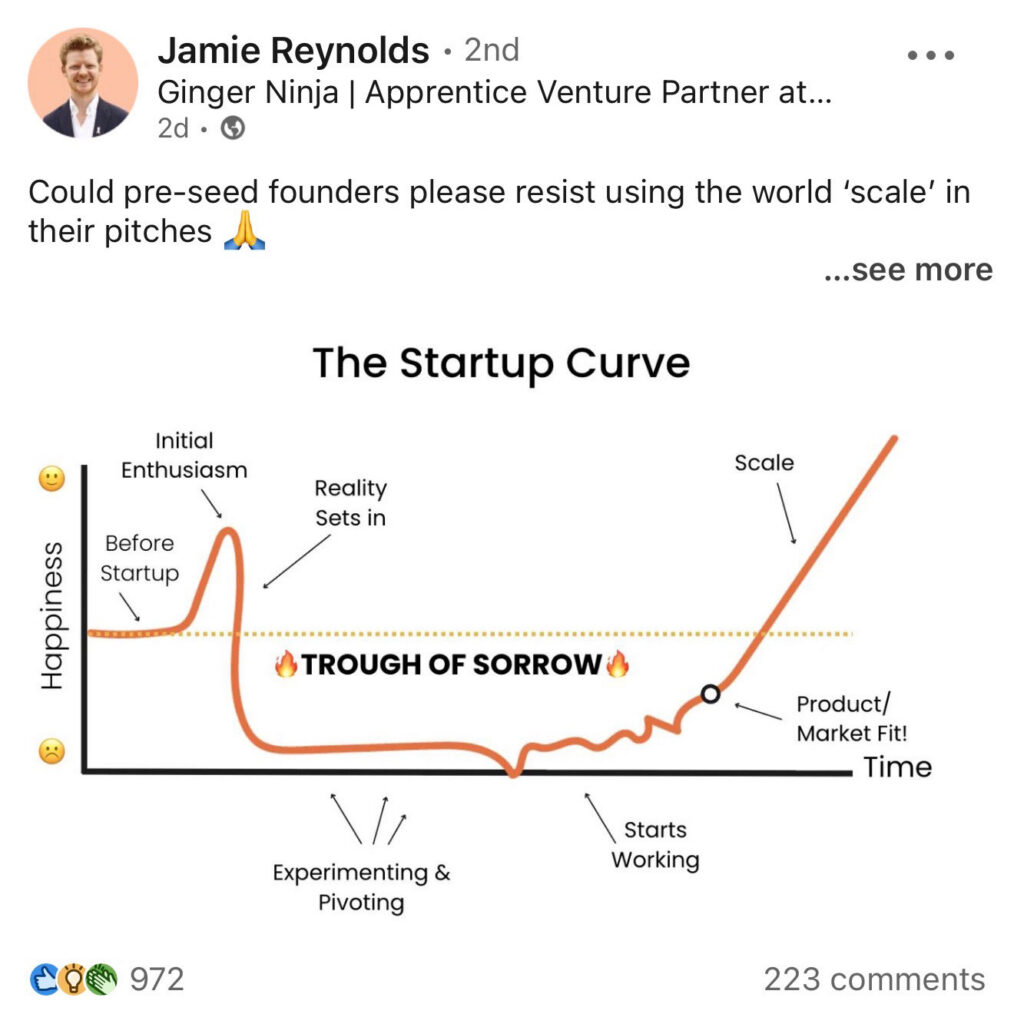
It depicts what Paul Graham called the “Trough of Sorrow” as a little joke describing the life of a product at a YCombinator dinner a number of years ago (source Andrew Chen).
Which got me thinking…
With all my experience in founder performance psychology, neither the “trough of sorrow” (existential crisis during the early startup phase of experimentation and pivoting) nor “elated happiness” that was expected during the startup scaling or exit phase were a necessary experience.
So at first I expanded and separated the startup success from the founder’s level of happiness into what turned out to be a Founder Success Matrix:
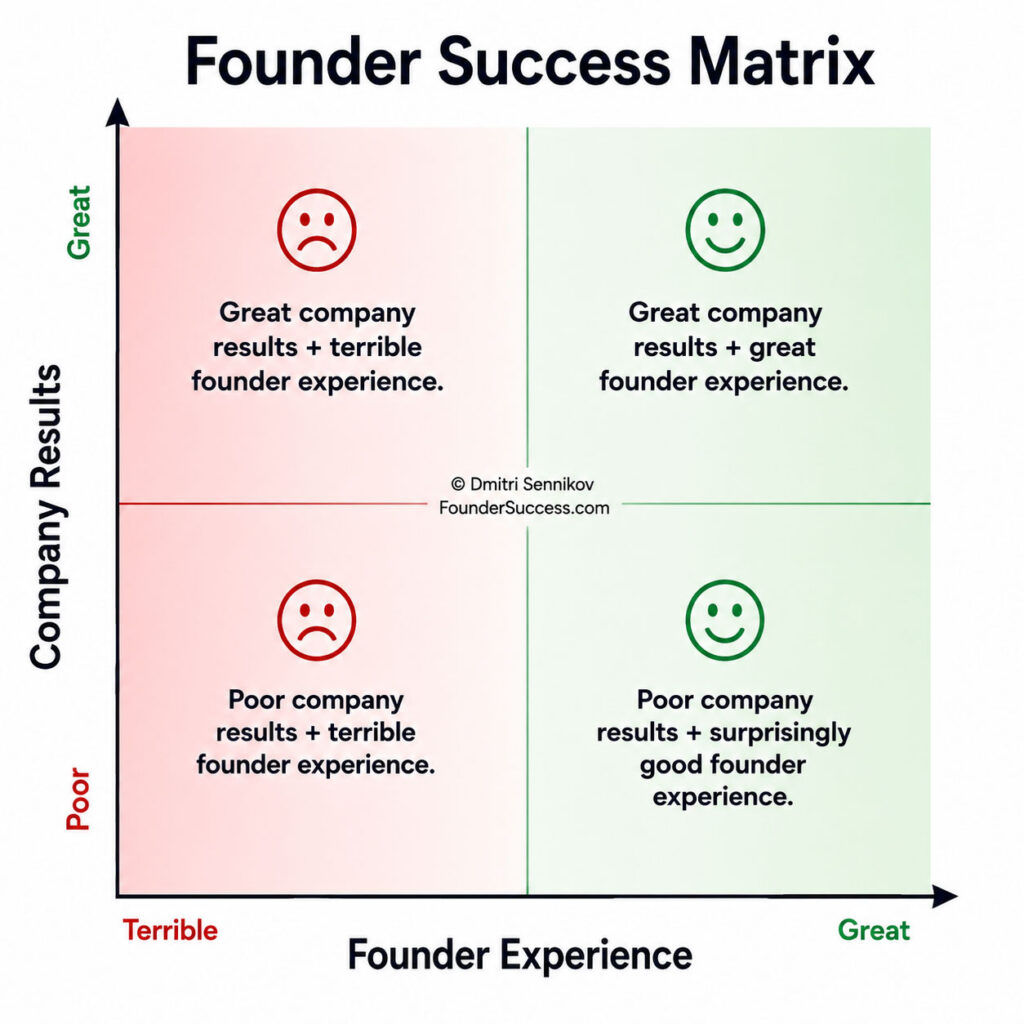
Which clearly shows that both a company doing well could be a miserable experience for the founder, and also the absence of any measurable external startup results could be experienced in a completely curious and excited state.
And then I further tinkered with the earlier Startup Curve that popped up into my awareness on my LinkedIn feed, and overlayed the Founder Experience on top of Startup Success journey.
Alas, here’s an absolutely clear way to see the Founder Experience Curve:
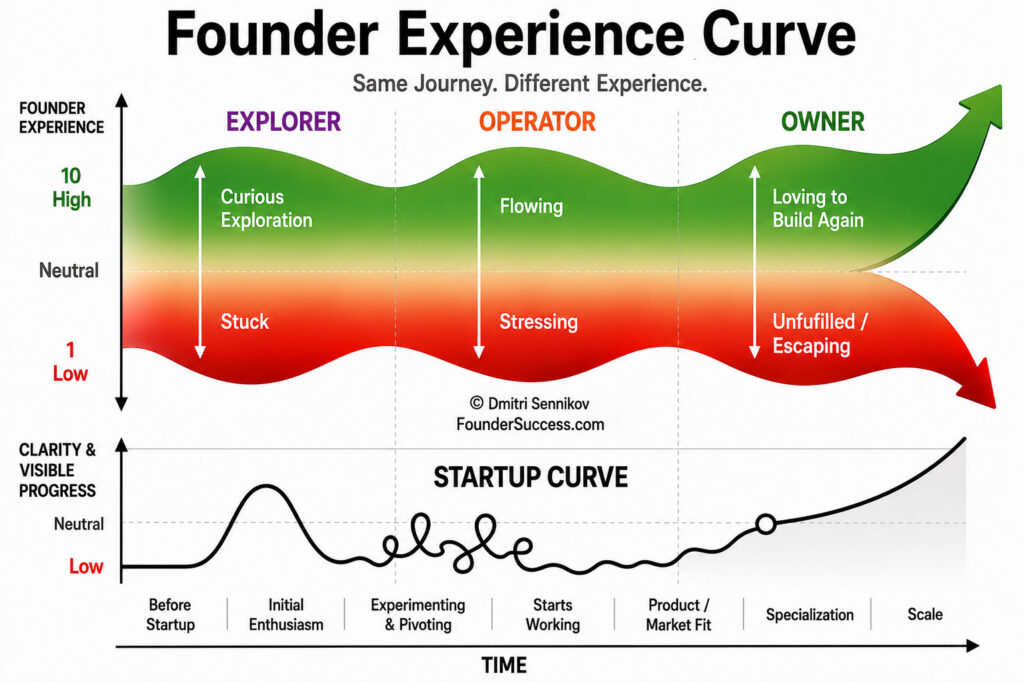
As you can notice, pretty much any phase of a startup journey could be experienced as both an awful thing to tolerate and endure through:
1) States of being stuck, stressing, or being completely unfulfilled and attempting to escape.
OR an experience of pure play and excitement:
2) States of total focus on curious exploration, flow, exhilaration, and love of creation, uncertainty, and watching what comes along with it all.
The phenomenon it clearly shows is also the devastating discovery many of those that do reach scale and exit… that they don’t actually bring much happiness, if any at all!
A new dimension of startup success to explore is the success of the founder’s experience
In a world where we’ve mastered the startup game, now whatever the strategy you need for startup success at your particular phase you can just ask any AI, and it’ll give you enough things to do for the next 12 months.
But this mostly unexplored area of founder success and elevated experience is something not as easily reached nor any particular one strategy has been as effective as one would hope.
Yes we have the oura rings, the yoga sessions, breathwork, Costa Rica trips and retreats, but do those things truly impact the experience once we return back to working our startups in an attempt to bring our ideas and dreams into reality?!
This has been the area of exploration for me over the last decade.
If this is something of interest for you personally, DM and reach out.
If this is something you’re also interested in for your profession, research, also I would love to connect.
And if this is simply giving you a bit more of an insight of where you could be on your own startup curve journey at the moment, and giving you a possibility of a different view of how you could be experiencing this moment right now, then I’ve done my job well that I’ve truly intended.
Feel free to share with these concepts with others, bring your insights, AHAs, yea-butts. Could this be a new conversation in the world of startups, founders… and the definition of personal founder success? 🤔
– Dmitri Sennikov